
FACEACTIONS
Read the face. Quantify the feeling.
Real-time facial-expression analysis with quantified emotion, valence, and arousal — for research, UX testing, academic study, and content evaluation.
Access is gated — usage is reviewed against our Acceptable Use Policy before activation.
SESSION · #36
12.4s · 1 participant
EMOTION DISTRIBUTION
Valence
+0.42
Arousal
0.38
FACS · ACTION UNITS
AI summary · Predominantly positive engagement. Participant displays moderate happiness with brief surprise around 4–6s. No negative valence detected.
Designed for ethical, consent-based use.
Use is gated by our Acceptable Use Policy. Workplace surveillance, hiring decisions, educational assessment of individuals, law-enforcement applications, and clinical-grade medical use are prohibited. We require explicit subject-consent attestation at upload. Read the policy →
WHAT IT MEASURES
Quantified emotion. Per frame.
Eight emotion classes, valence, arousal, head pose, gaze, facial Action Units (FACS), and LLM-narrated summaries — all exportable.
8 emotion classes
Neutral · Happy · Sad · Angry · Surprised · Scared · Disgusted · Contempt
Valence + arousal
Continuous affect dimensions, frame-level, exportable
Head pose & gaze
Pitch / yaw / roll · eye state · gaze direction
FACS Action Units
Industry-standard facial muscle group activations
LLM narration
Natural-language session summary; per-speaker if multiple
Session-level export
CSV, JSON, video overlay — bring data into your stack
Multi-participant
Track multiple subjects in one video, separated by face ID
Quality flags
Per-frame confidence; low-confidence frames flagged
WORKFLOW
Capture. Analyze. Export.
Three concrete steps from raw video to research-ready data. No Windows install, no per-seat license, no on-prem hardware.
01
Capture
Webcam in real time, recorded video file (MP4 / MOV / WebM), or mobile browser. No installer — runs in any modern browser.
Multiple inputs02
Analyze
Per-frame inference for 8 emotion classes, valence, arousal, head pose, gaze, and FACS Action Units. Multiple subjects in one video, separated by face ID. Quality flags per frame.
Per-frame · per-subject03
Export
Real-time charts in the portal, CSV per frame, JSON event log, video overlay (tracked faces + labels), and an LLM-narrated session summary. Bring the data into your existing research stack.
CSV · JSON · video · LLM summaryBUILT FOR RESEARCHERS
Spend your time on the analysis while we handle the tooling.
Capture in the browser, get quantified emotion, valence, arousal, and FACS Action Units per frame, and export research-ready data. FaceActions handles the instrumentation so your team can focus on the questions that matter.

REAL FRAMES · REAL NUMBERS
Quantified reaction, frame by frame.
Tenant redacted. Subject consented to public display. This is what the portal actually looks like during a session — no rendered marketing mock-ups.
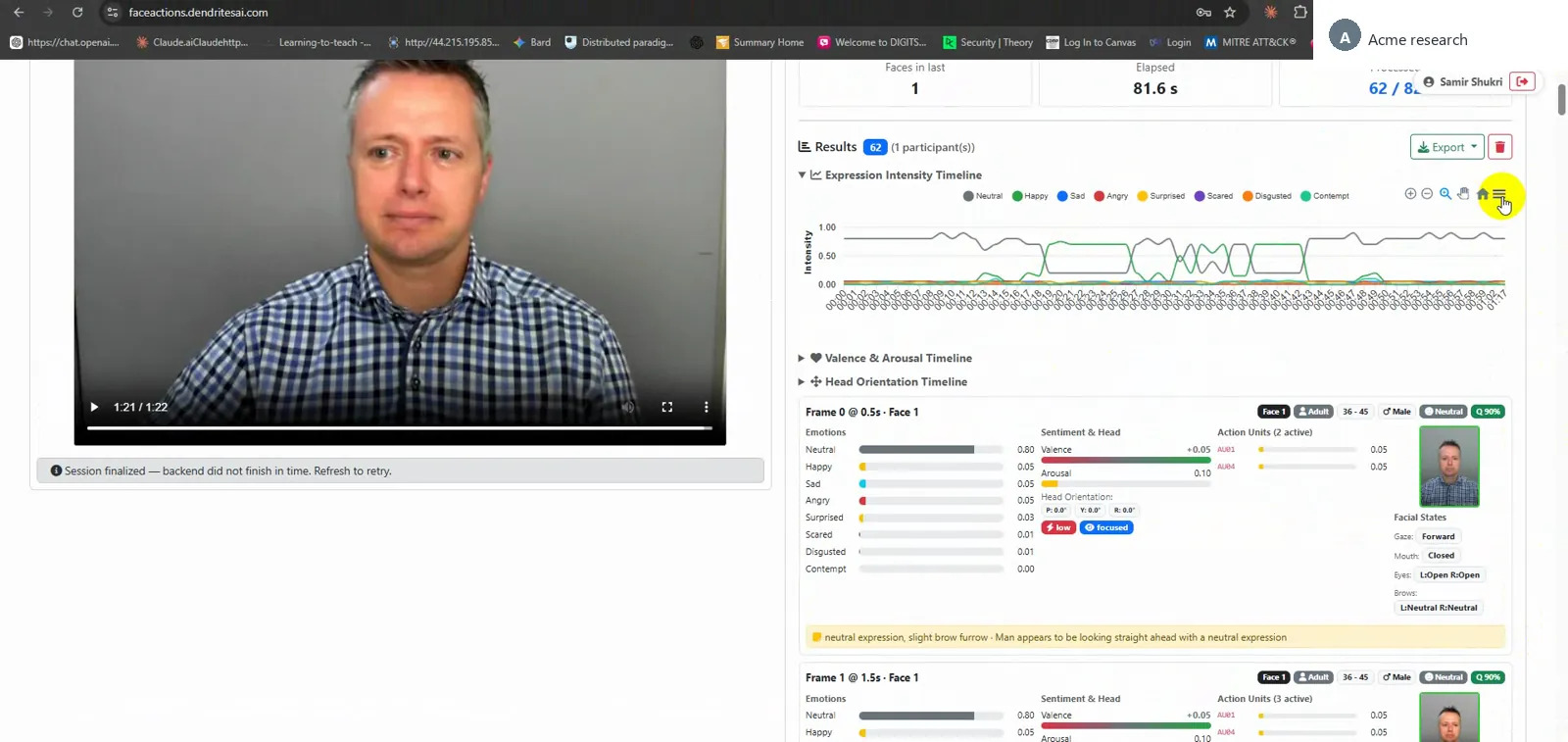
Session view
One screen brings the playback, the eight-emotion-class intensity timeline, and the per-frame breakdown together. Capture stats (frames captured, faces detected, elapsed time, processed count) sit above the chart. Export to CSV / JSON / video overlay from the top-right.
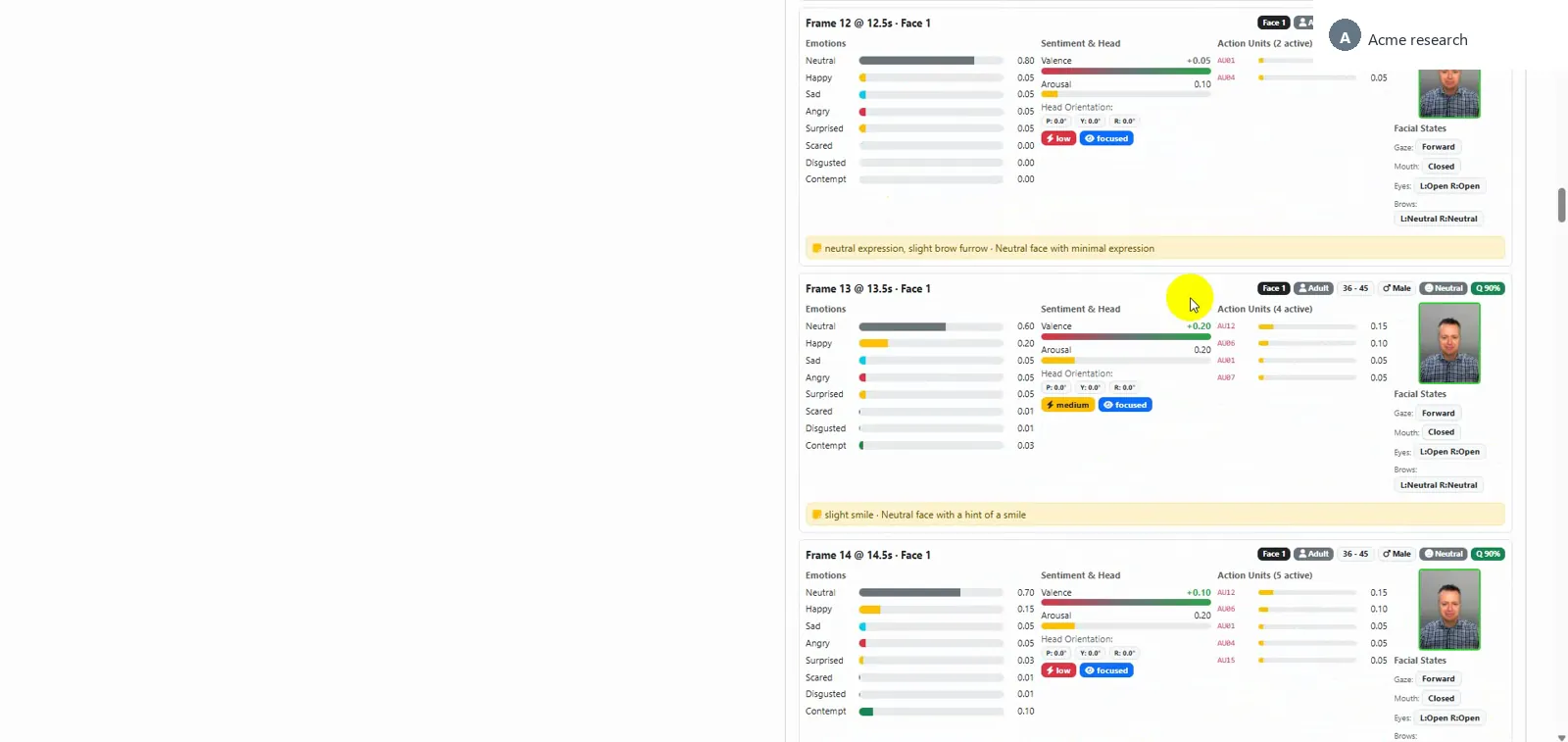
Per-frame detail
Three consecutive frames, side-by-side, with the full instrumentation visible: eight emotion classes, valence, arousal, head orientation, active Action Units, and facial states (gaze · mouth · eyes · brows). Every frame is independently inspectable — there's no aggregation that hides the data underneath.
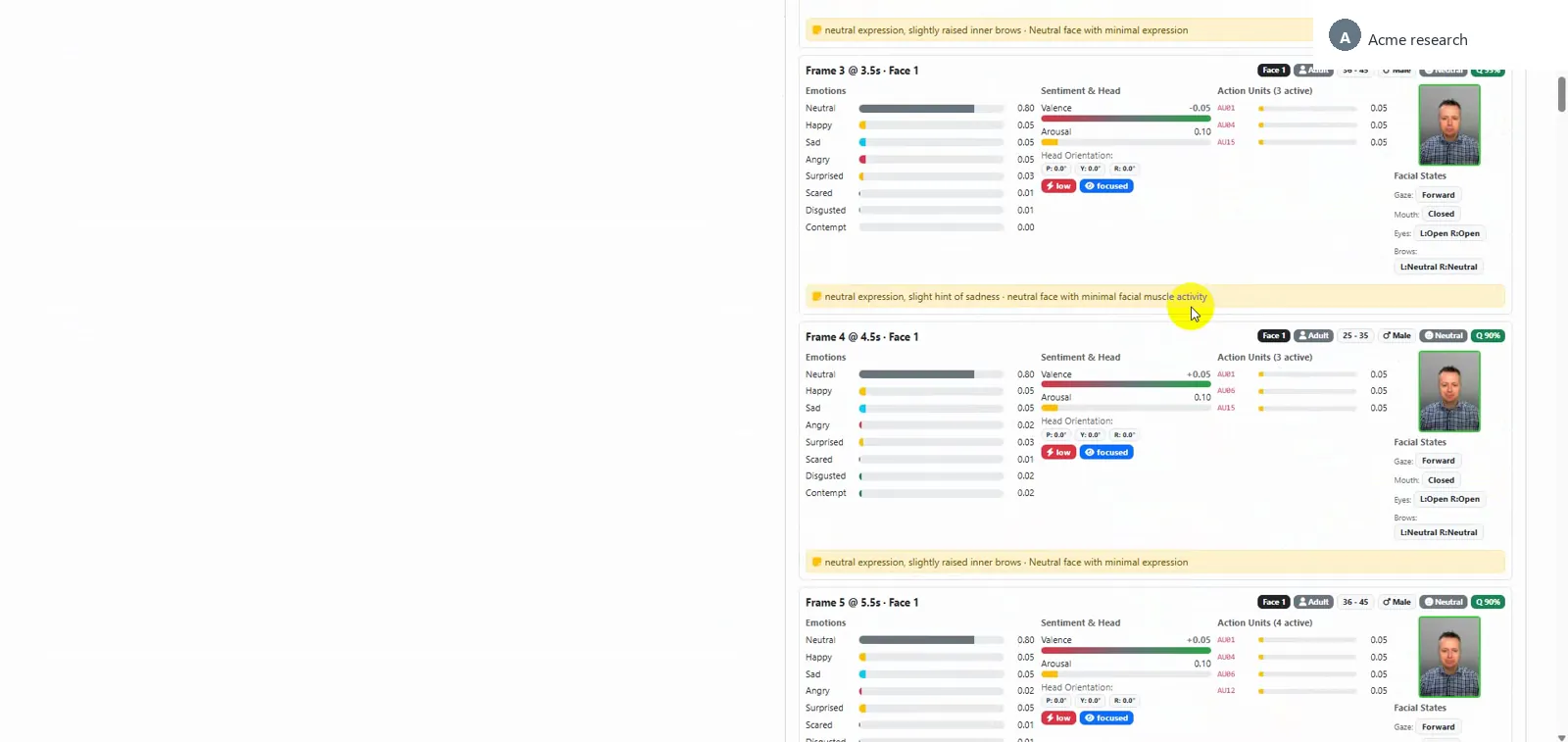
LLM-narrated descriptions
Below every analyzed frame, a short plain-language description ("neutral expression, slightly raised eyebrows", "slight smile, slight hint of sadness") generated from the model's actual readings. Useful for skim review, qualitative annotation, and reproducibility checks — exportable alongside the numerical data.
WHY FACEACTIONS
Built for 2026 — not retrofitted from a desktop era.
Legacy emotion-AI tools were built when Windows installs and per-seat licensing were the norm. FaceActions starts from cloud-native and ethical-by-design defaults that the regulatory environment now requires.
Cloud-native, browser-only
FaceActions: Runs in any modern browser. Capture on a phone, analyze in a shared workspace, share results by link.
Typical legacy tool: Windows desktop installer per machine. Files exchanged by USB or SharePoint.
Multi-tenant workspace
FaceActions: One portal, many tenants. Lab and industry side-by-side with separated data, separate users.
Typical legacy tool: Per-seat licenses; data lives on individual researchers' laptops.
LLM-narrated session summaries
FaceActions: Plain-language narrative of what happened in the session — per subject, exportable alongside the numerical data.
Typical legacy tool: Numbers and charts only; narrative coding done manually after the fact.
Ethical-use gating, built in
FaceActions: Workplace surveillance, hiring decisions, educational assessment of individuals, law-enforcement applications, and clinical-grade medical use are prohibited at the AUP and product level. Consent attestation logged at every upload.
Typical legacy tool: Use-case enforcement left to the buyer; broad permissible use sometimes inconsistent with EU AI Act and BIPA.
EU AI Act + GDPR Art. 9 ready
FaceActions: Designed against the 2026 regulatory baseline. DPIA available on request; sub-processors named at /security.
Typical legacy tool: Retrofitting compliance into legacy architecture; DPIA often customer-authored.
Calibrated language about AI
FaceActions: We detect facial expressions associated with emotional states — not "emotions" as ground truth. Per-frame confidence reported; low-confidence frames flagged.
Typical legacy tool: Marketing language that implies direct emotion detection without qualification.
"Legacy tools" refers to the category broadly — established desktop-installed emotion-analysis software in active use across psychology, neuroscience, UX, and market research. We respect the category; we built FaceActions to give research teams a modern alternative on the same data shape.
PERMITTED USES
Productive, ethical, evidence-based.
The use cases we built for. Anything outside this list, we'll discuss before activation — and some categories (clinical, hiring, surveillance) are off-limits regardless.
UX research
Moderated and unmoderated usability studies. Quantify reactions across cohorts.
Content evaluation
Test video and ad creative against measured viewer expression and arousal.
Academic research
Reproducibility-friendly export. Academic license available for university research groups.
Accessibility
Detect attention and emotional state for adaptive interfaces and assistive tools.
Market research
Focus-group reaction data, quantified and exportable.
Training & coaching
Self-paced practice playback for public-speaking, sales coaching, and interview prep — with consent.
ETHICS & APPROACH
Emotion AI, done thoughtfully.
Emotion-recognition AI is one of the most regulated AI subcategories in 2026. We designed FaceActions to lead with the right defaults — not retrofit them under regulatory pressure.
- ● EU AI Act — we do not enable workplace or educational emotion recognition.
- ● GDPR Art. 9 — facial biometrics treated as special-category data; explicit consent required at upload.
- ● BIPA / state biometric laws — consent flow logs subject attestation at every upload.
- ● No clinical use — we don't position FaceActions for medical diagnosis or telehealth, and we don't sign BAAs. If you need clinical-grade tools, we're not the right vendor.
- ● Calibrated language — we detect facial expressions associated with emotional states, not "emotions" as ground truth.
ACADEMIC & RESEARCH
Licensed for the way research actually works.
Discounted academic licensing for verified universities and research institutes. Reproducibility-friendly export (CSV, JSON, video overlay, LLM narration), cite-ready methodology page, and consent-attestation logs that satisfy IRB review and GDPR Article 9.
Request academic pricing →Academic discount
Verified universities + research institutes
IRB-ready
Consent attestation logged per upload
Reproducible
Frame-level CSV / JSON · stable methodology
Citable
Methodology page with version + revision history
START
Ready for serious emotion research?
Talk to our research team. We'll walk through your use case, confirm fit, and get you onto a license that matches.